


Data Security & Resilience
What Is Operational Resilience?
Learn how to build operational resilience against cyber threats, outages, and disruption, with best practices aligned to FCA, PRA, and DORA.

Secure data optimisation & proactive backup
Proactive Licensing, Compliance & Asset Management
Agile, Modular, & Secure Cyber Security & Managed Siem
Manage & Transform Multi-Cloud, Hybrid & On-Premise
Operational Resilience is your organisation’s ability to anticipate, prepare for, respond to, and adapt to disruption while continuing to deliver its critical services. Operational resilience is often conflated with disaster recovery, but the key difference is that operational resilience means remaining functional through cyberattacks, system failures, supply chain issues, or other unforseen events.
In regulated sectors such as financial services, firms must meet evolving expectations from regulators like the FCA, PRA, and under EU DORA, demonstrating they can continue to deliver important services within defined impact tolerances even under severe scenarios.
Many organisations mistakenly think resilience is only about backups or disaster recovery, but it’s actually a strategic capability that spans culture, governance, strategy, and technology.
Business continuity focuses on recovery, whereas operational resilience focuses on maintaining critical services and limiting impact before, during, and after disruption or a breach.
Operational resilience is essential because disruption is inevitable and the consequences of being unprepared are significant. These include:
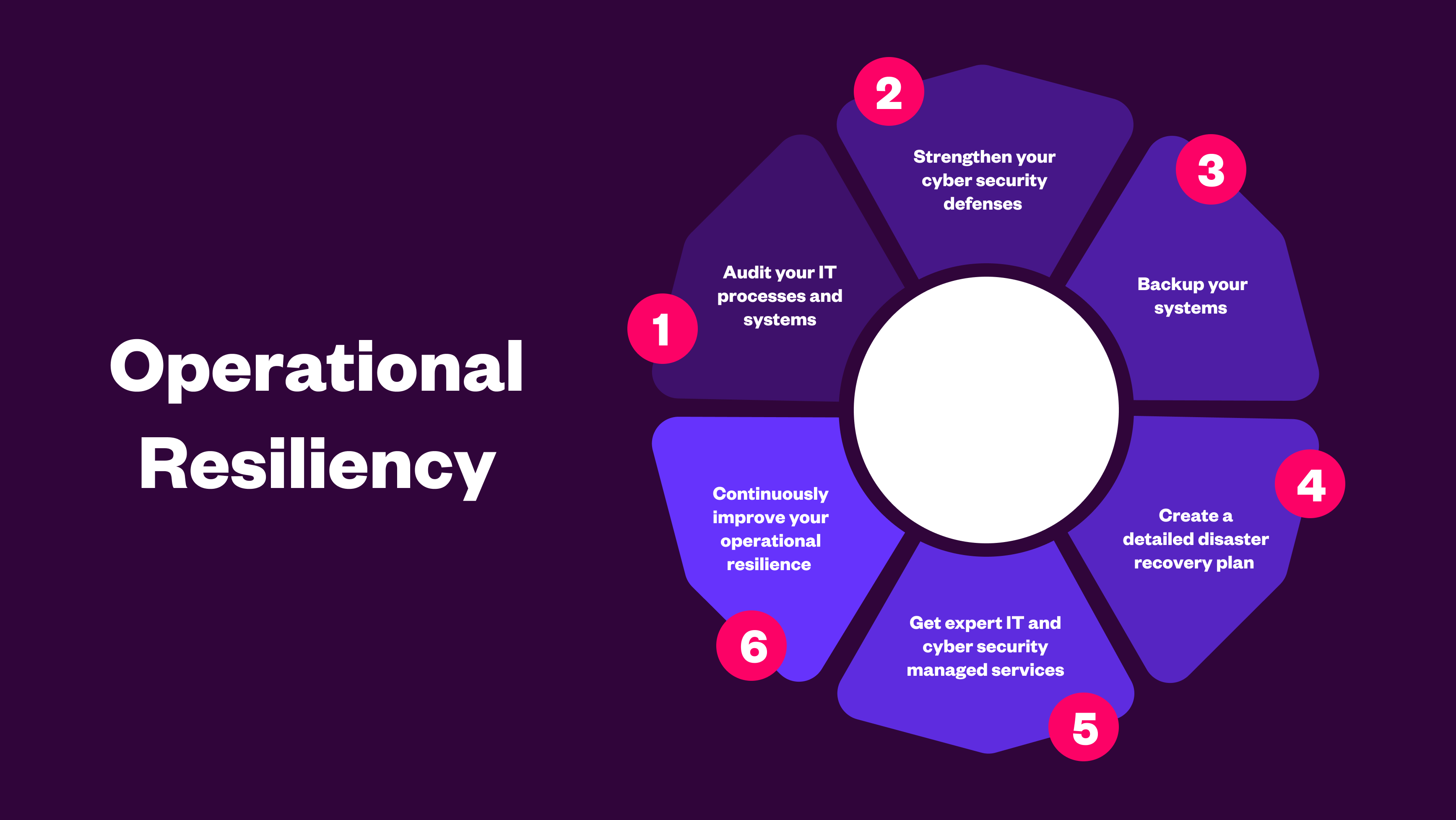
Implementing Operational Resilience is a structured, ongoing process spanning strategy, governance, technology, and culture. The struggle often lies in switching from a reactive to an always-on approach. Below is a best-practice implementation approach:
1. Define Critical Services and Get Board Buy-in
Identify the services most essential to customers and regulators, then map out dependencies across systems, data, personnel, and third parties. This step requires board-level buy-in to ensure resilience priorities reflect business and regulatory risk, so it’s essential to ensure the board understand the importance of operational resilience.
2. Set Impact Tolerances
Decide how much disruption is acceptable for each critical service, such as maximum downtime or data loss, and align with regulatory expectations (FCA, PRA, DORA, etc.).
3. Risk Assessment and Scenario Testing
Assess threats such as cyberattacks, outages, and supply chain failures. Run severe but plausible scenarios to test whether impact tolerances can be met and refine plans based on results.
4. Build Resilient Architecture
Design systems for redundancy and rapid recovery:
This aligns your technical stack with your broader resilience goals.
5. Business Continuity and Disaster Recovery
Document and frequently test your business continuity and disaster recovery (DR) plans. Use recovery assurance processes to ensure backups are secure, recoverable, and free of threats. Ensure staff understand roles and escalation paths during incidents.
6. Third-Party Risk Management
Assess the resilience and recovery capability of vendors and partners. You should also include resilience obligations in contracts.
Regulators increasingly expect firms to demonstrate oversight of critical third parties as part of resilience programmes.
7. Continuous Improvement
Operational Resilience is ongoing. Continuously monitor, test, and update plans using key performance indicators such as uptime, response times, and recovery effectiveness.
Consistent review also prepares you for emerging threats and regulatory updates.
At Celerity, our expert consultancy and managed services help you build, test, and mature your Operational Resilience strategy, from planning and cyber risk assessment to automated recovery, monitoring, and compliance support.
Whether you need:
Our team ensures your resilience framework is robust, practical, and aligned with regulatory expectations.
Talk to our specialists today to strengthen your Operational Resilience and future-proof your organisation.
Learn how to build operational resilience against cyber threats, outages, and disruption, with best practices aligned to FCA, PRA, and DORA.
.png)
Vibe coding leads to reliance on familiar patterns, quick fixes, and unchecked dependencies. Learn how these hidden risks expose organisations to cybe...
.png)
Key Takeaways AI in cyber security helps organisations detect, prevent and respond to evolving threats faster than traditional security tools. AI-powe...