How cyber security managed services reduce breach risk, improve response times, and give you 24/7 protection
Most breaches are not caused by a lack of security tools. They happen because threats aren’t detected in time. Attackers don’t need weeks. In many cases, they move within hours. Data is exfiltrated before anyone raises an alert. By the time the incident is visible, the damage is already done, and the company is facing the fallout, with the average data breach costing $4.4 million. This is the gap cyber security managed services are designed to close.
They provide continuous monitoring, detection, and response across your environment. Not just visibility, but action. Not just alerts, but containment. For most organisations, that shift is the difference between a contained incident and a business disruption.
This guide breaks down why traditional models are falling short, what actually happens without managed security in place, and how cyber security managed services change the outcome.

Why traditional security models are failing
Most organisations have invested heavily in security tooling. SIEM platforms. Endpoint protection. Firewalls. Identity controls. The problem is often not the tools. It’s how they operate.
Tool sprawl without coordination
Security stacks have grown quickly. Cloud, SaaS, endpoints, and hybrid infrastructure all introduce new control points. Each comes with its own telemetry, alerts, and management overhead. Without centralised monitoring and correlation, those signals stay isolated. Critical indicators are missed because no one is connecting them, resulting in organisations taking 277 days to identify and contain breaches, on average. The result: visibility exists, but insight does not.
No true 24/7 coverage
Threat actors do not work office hours. Most internal teams do. Even well-resourced IT functions struggle to maintain round-the-clock monitoring. Nights and weekends create gaps. Those gaps are where attacks succeed. A delayed response is often the difference between a single compromised endpoint and a full environment-wide incident.
Alert overload with no response capability
Modern security tools generate volume. Thousands of alerts per day is not unusual. Without dedicated analysts to triage and investigate, false positives consume time, real threats are buried, and response is delayed or inconsistent. This is where most traditional models break. Detection without response is not protection.
Skills gap at the point it matters
Experienced SOC analysts, threat hunters, and incident responders are in short supply. Hiring is slow, retention is difficult and training takes time. Even if the tools are in place, the capability to operate them effectively often isn’t, as a 2024 survey shows, 62% of alerts are ignored entirely, and accuracy drops by 40% after extended shifts.
The outcome is that organisations have visibility, but not control. Alerts, but not action. Tools, but not outcomes. That is why cyber security managed services are becoming an operational requirement, not an enhancement.
What happens without managed security
To understand the value of cyber security managed services, it helps to look at what actually happens during a typical breach. Not the theory. The sequence.
Stage 1: Initial compromise
An attacker gains access through a common entry point such as a phishing email, compromised credentials, or an unpatched vulnerability. At this stage, the signal is weak. A login anomaly. A suspicious process. Easy to miss in isolation.
Stage 2: Establishing persistence
The attacker ensures they can return. They create new accounts, modify permissions and install backdoors. These actions often generate alerts. But without correlation, they don’t trigger a response.
Stage 3: Lateral movement
The attacker explores the environment. They move between endpoints, escalate privileges and access critical systems. This is where the risk accelerates. The longer this phase continues, the greater the impact.
Stage 4: Data access and exfiltration
Sensitive data is located and extracted, including customer data, financial records, and intellectual property. At this point, the breach has moved from risk to impact.
Stage 5: Detection (too late)
In many cases, detection happens after a system fails, data appears externally, or a third party reports suspicious activity. Response begins after the damage is done. The pattern is consistent: The attack is not invisible. It is simply not acted on quickly enough. Without continuous monitoring, correlation, and response, organisations are always reacting late.
How managed security services change the outcome
Cyber security managed services change one thing that matters most: timing. They reduce the gap between signal and response.

Early detection through continuous monitoring
Instead of isolated alerts, managed services correlate activity across endpoints, networks, cloud environments, and identity systems. Weak signals become visible patterns. Suspicious behaviour is identified early, not after escalation.
Faster response and containment
Detection alone is not enough. Action is what changes the outcome. Managed security services provide immediate triage of alerts, investigation by experienced analysts, and automated or guided containment actions. That means compromised accounts are disabled quickly, malicious processes are stopped, and lateral movement is contained. The attack is interrupted before it spreads.
Reduced dwell time
Dwell time is the period between compromise and detection. Shorter dwell time means less data exposure, lower recovery costs, and reduced operational disruption. This is one of the most measurable impacts of cyber security managed services.
Consistent 24/7 coverage
Monitoring does not stop. Response does not slow. Whether it’s 2pm or 2am, threats are detected, investigated, and acted on. This removes the coverage gaps that attackers rely on.
From reactive to operational security
Without managed services, security is often reactive. With cyber security managed services, it becomes operational through continuous monitoring, defined response processes, and measurable performance (MTTD, MTTR). This is where security starts to deliver real business outcomes. The difference is simple: The same attack chain can occur. The outcome is completely different. One leads to disruption. The other is contained before it becomes visible.
Inside a modern managed security service
Most providers claim to offer monitoring and response. The difference is in how those capabilities are delivered, integrated, and operated. Modern cyber security managed services are not a single tool or platform. They are an operational model built across multiple layers of technology, people, and process. Here is what that looks like in practice.
Centralised telemetry and data correlation (SIEM)
At the core sits a Security Information and Event Management (SIEM) platform. Its role is simple in principle: ingest and correlate data from across your environment. In practice, that means pulling in endpoint activity, network traffic, cloud logs, identity and access events, and application behaviour.
Individually, these signals are low value. Together, they form patterns. A failed login is noise and a failed login followed by privilege escalation and unusual data access is a threat. That correlation is what turns visibility into detection. However, SIEM alone does not solve the problem. Without tuning, context, and active management, it becomes another source of noise. In a managed model, SIEM is continuously tuned to reduce false positives, updated with new detection rules, and aligned to your environment and risk profile. This is where most in-house deployments fall short.
Endpoint detection and response (EDR/XDR)
Endpoints remain the primary attack surface. Laptops, servers, and cloud workloads are where attackers execute code, escalate privileges, and move laterally. EDR (Endpoint Detection and Response) provides deep visibility at this level, including process execution, file changes, memory activity, and user behaviour. XDR (Extended Detection and Response) expands this further by linking endpoint data with network and cloud telemetry.
The outcome is faster identification of malicious processes, ransomware activity, credential misuse, and insider threats. In a managed service, this capability is not passive. Analysts actively investigate suspicious behaviour and determine whether it represents real risk. That distinction matters. Tools detect. People decide.
Managed detection and response (MDR / MXDR)
This is where cyber security managed services move from monitoring to action. Managed Detection and Response (MDR), or Managed Extended Detection and Response (MXDR), provides continuous threat monitoring, alert triage and validation, incident investigation, and containment and remediation.
The key difference is accountability. Instead of handing alerts back to your internal team, the provider confirms whether an alert is malicious, explains the impact, and takes or recommends immediate action. For example, disabling compromised accounts, isolating infected endpoints, or blocking malicious IPs. This reduces the burden on internal teams and removes the delay between detection and response.
Security Operations Centre (SOC)
All of this capability is orchestrated through a Security Operations Centre. A modern SOC is not just a room with screens. It is a structured operating model built around tiered analysts (triage, investigation, threat hunting), defined escalation paths, standardised response playbooks, and continuous monitoring workflows.
In a managed service, the SOC operates 24/7. There are no gaps in coverage, it provides consistent responses regardless of time and provides faster containment of threats. It also provides access to skills that are difficult to build internally, including threat hunters, incident responders, and detection engineers. This is one of the most immediate benefits for organisations struggling with the security skills gap.
Threat intelligence and proactive defence
Reactive detection is not enough. Modern cyber security managed services integrate threat intelligence to stay ahead of known attack patterns. This includes This includes indicators of compromise (IOCs), tactics, techniques, and procedures (TTPs), and industry-specific threat trends.
This intelligence is used to to update detection rules, prioritise alerts, and identify emerging risks before they are exploited. Over time, this shifts the model from reactive to proactive. Instead of waiting for an alert, the service actively looks for signs of compromise.
Automation and orchestration
Speed is critical during an incident and manual processes introduce delays, which increase impact. Automation addresses this by triggering predefined response actions, enriching alerts with context, and reducing repetitive analyst tasks.
For example, automatically isolating a device showing ransomware behaviour, enriching an alert with user, device, and location data, or blocking known malicious domains in real time. This does not replace human decision-making. It accelerates it. The result is a faster, more consistent response at scale.
Reporting, visibility, and accountability
A managed service must provide clear, actionable reporting. Not dashboards filled with noise or information that supports decision-making. This includes incident summaries and root cause analysis, trends in threat activity, performance against SLAs (MTTD, MTTR), and recommendations for improvement. For CIOs and CISOs, this creates visibility into risk, evidence for compliance, and a basis for strategic decisions.
What this means in practice
Cyber security managed services are not just an outsourced SOC. They are a coordinated system designed to detect threats earlier, respond faster, and reduce operational risk. The value comes from how these components work together, not from any single technology.
The role of automation in modern managed security
Most organisations underestimate how quickly security operations break under scale. More endpoints. More users. More cloud services. More alerts. Without automation, the model does not hold.

Why manual security operations fail
Manual workflows introduce three consistent problems:
-
Slow response times: Every alert requires investigation. Every investigation takes time. During that time, attackers continue to move.
-
Inconsistent decision-making: Different analysts make different calls. That leads to missed threats, unnecessary escalations and inefficient responses.
-
Analyst fatigue: High alert volumes lead to burnout. Burnout leads to mistakes.
What automation actually does
Automation is not about replacing analysts. It is about removing friction. In a managed service, automation is used to:
-
Prioritise alerts: High-risk incidents are surfaced immediately
-
Enrich context: Alerts are automatically populated with relevant data
-
Trigger initial response actions: Known threats are contained without delay
-
Standardise workflows: Every incident follows a defined, repeatable process
Where automation delivers the most value
-
Alert triage: Filtering out noise and identifying what matters
-
Incident response: Executing containment actions quickly and consistently
-
Threat correlation: Linking events across systems without manual effort
The outcome: speed and consistency
Automation reduces the time between detection and investigation, and between investigation and response. That directly impacts dwell time, data exposure, and business disruption. For organisations adopting cyber security managed services, this is one of the most immediate performance improvements.
Measuring success: what good looks like
Security performance is often discussed in abstract terms. Strong posture. Reduced risk. Improved resilience. That is not enough.
Cyber security managed services should be measured in operational terms.

Mean time to detect (MTTD)
MTTD measures how quickly a threat is identified after initial compromise. Shorter MTTD means less time for attackers to move laterally, earlier containment, and reduced impact. A well-operated managed service significantly reduces detection time through continuous monitoring and correlation.
Mean time to respond (MTTR)
MTTR measures how quickly a confirmed threat is contained. This includes investigation, decision-making, and execution of response actions. Lower MTTR directly reduces operational disruption, recovery cost, and risk exposure.
Dwell time
Dwell time combines detection and response. It is one of the most important indicators of security effectiveness. Long dwell times indicate missed signals, delayed response, and increased risk. Cyber security managed services are designed to minimise this.
Incident containment rate
Not all incidents are equal. What matters is how many are detected early and contained before escalation. High containment rates indicate effective detection, fast response, and strong operational processes.
False positive reduction
High volumes of false alerts reduce efficiency. A mature managed service continuously tunes detection rules, reduces noise, and improves signal quality. This allows teams to focus on real threats.
Coverage across the environment
Security is only as strong as its weakest visibility point endpoints, networks, cloud platforms, and identity systems. Gaps in coverage create blind spots. Blind spots create risk.
Alignment with business risk
Technical metrics matter. Business impact matters more. Security performance should link to reduced likelihood of disruption, faster recovery from incidents, and protection of critical data. This is where cyber security managed services move from IT function to business enabler.
Build vs buy: why managed services win for most organisations
Running an effective security operation internally is possible. But for most organisations, it is just not practical.
-
The true cost of an in-house SOC: Building an internal capability requires SIEM and EDR/XDR platforms, skilled analysts across multiple tiers, 24/7 coverage, ongoing training and development, and continuous tooling optimisation. Costs scale quickly and more importantly, complexity increases.
-
The reality of the skills market: Security talent is limited. Hiring challenges include high salary expectations, long recruitment cycles, and high attrition rates. Even when roles are filled, maintaining capability is difficult.
-
Time to operational maturity: An internal SOC does not become effective overnight. It requires months of tuning, process development and integration work. During that time, exposure remains.
-
What managed services change: Cyber security managed services provide immediate access to skilled analysts, established processes and playbooks, pre-integrated tooling, and continuous optimisation. This accelerates time to value.
-
Economics of scale: Providers operate across multiple environments. That creates efficiencies in tooling, threat intelligence, and operational processes. These efficiencies are difficult to replicate internally.
When in-house still makes sense
There are cases where internal capability is justified, including highly regulated environments, large enterprises with existing SOC maturity, and organisations with specific operational requirements. Even in these scenarios, co-managed models are common.
The conclusion is straightforward: Most organisations do not fail because they lack tools. They fail because they cannot operate those tools at the speed and scale required. Cyber security managed services close that gap.
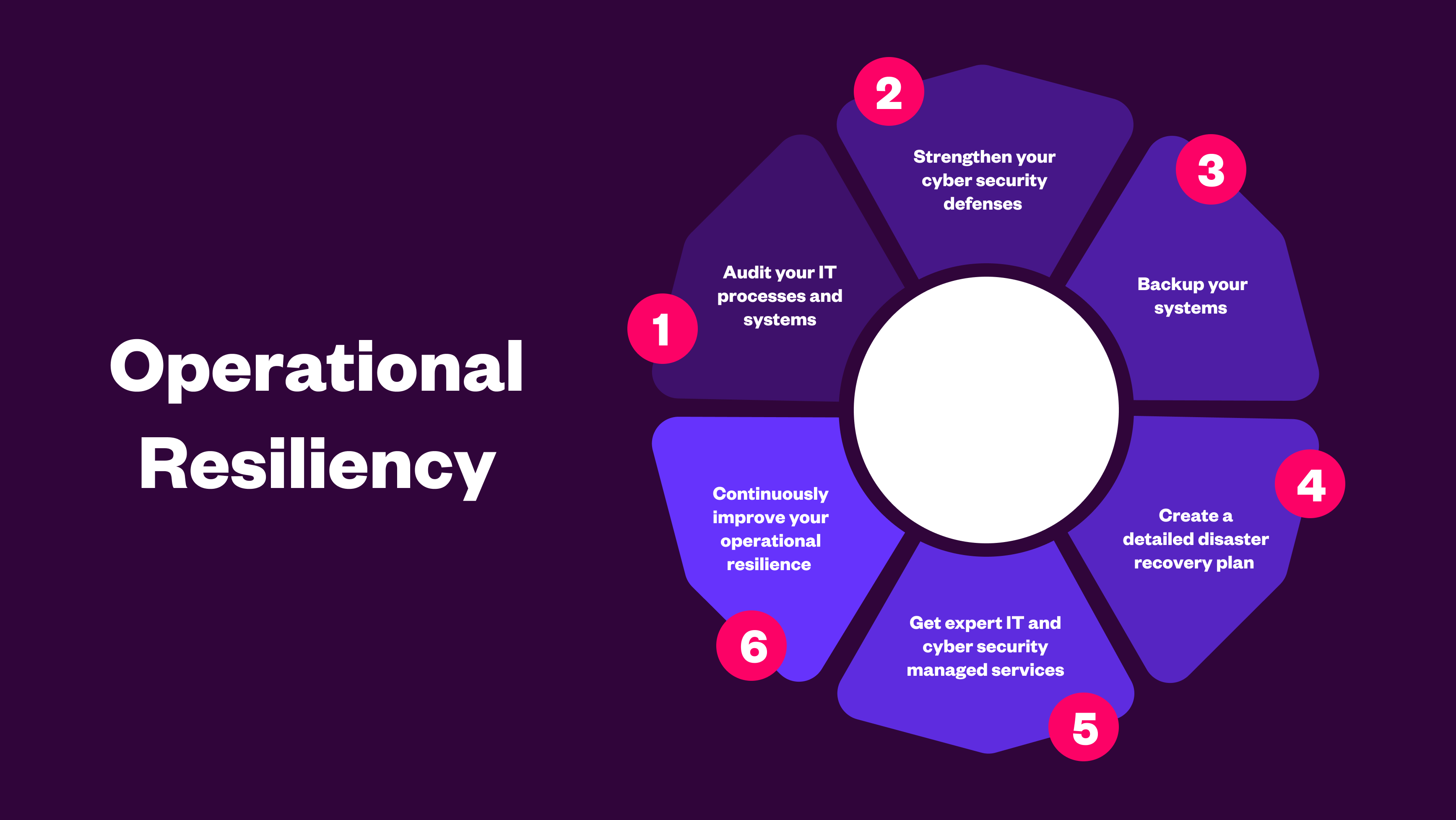
Where managed security fits in a resilience strategy
Security does not operate in isolation. Detection and response are only one part of a broader resilience model.
-
Security and data resilience: Even with strong detection, incidents will occur. When they do, recovery speed matters. This is where alignment with backup and recovery becomes critical for clean data recovery, ransomware resilience, and reduced downtime.
-
Security and identity: Identity is a primary attack vector. Managed security services must integrate with identity and access management and privileged access controls. This ensures compromised accounts are quickly identified and access is restricted before escalation.
-
Security and infrastructure: Hybrid environments increase complexity. Managed services must provide visibility across on-premise systems, cloud platforms, and remote endpoints. Without this, blind spots remain.
-
Security as an operational discipline: When integrated properly, cyber security managed services become part of daily operations. Not a reactive function. A continuous one that enables faster detection, response and recovery.
Selecting the right managed security approach
Not all services are equal. Choosing the wrong model creates the same problems as no service at all.
Fully managed vs co-managed
-
Fully managed: Provider owns detection and response with minimal internal involvement. This is suitable for organisations with limited security resources.
-
Co-managed: Responsibility is shared between the provider and the internal team. This offers greater flexibility and allows internal teams to retain control over certain functions.
Key factors to evaluate
Key considerations include depth of monitoring and coverage, response capabilities (not just alerting), integration with existing tools, SLA commitments (MTTD, MTTR), and transparency and reporting.
The question to ask
Not “what tools are included?”, instead 'How quickly will this service detect and stop a real attack in our environment?'. That is what matters.
Conclusion
Security outcomes are defined by speed. How quickly you detect. How quickly you respond. How quickly you recover. Most organisations already have the tools. What they lack is the operational capability to use them effectively. Cyber security managed services provide that capability through continuous monitoring, rapid response, and measurable performance.
The result is not just better security. It is fewer disruptions, lower risk, and greater confidence in your ability to operate under pressure. That is the difference between reacting to incidents and controlling them.
About Celerity
Celerity helps organisations reduce risk, respond faster, and operate with confidence under pressure. As an IBM Platinum Partner with over 20 years of enterprise IT experience, we design and deliver cyber security managed services that go beyond monitoring. The focus is simple: detect threats earlier, contain them faster, and minimise business impact.
Our approach combines 24/7 threat detection and response, deep integration across your existing environment, and proven operational models aligned to real-world risk. The result is measurable. Faster MTTD. Faster MTTR. Fewer incidents that escalate into disruption. Security should not rely on best effort. It should be predictable, accountable, and built to perform when it matters.
Protection starts with a conversation. Let’s talk.




.png)
.png)