How managed cyber security services improve threat detection, reduce risk, and strengthen operational resilience
Cyber attacks are no longer isolated IT incidents. They are operational disruptions with financial, regulatory, and reputational consequences attached. Ransomware was present in 44% of breaches in Verizon’s 2025 Data Breach Investigations Report, up 37% year-on-year. Meanwhile, IBM’s 2025 Cost of a Data Breach Report found the global average cost of a breach reached $4.44 million. Most organisations already own security tools. Firewalls. Endpoint protection. Email filtering. Backup platforms. SIEMs.
The problem is operational coverage. Threat actors operate 24/7. Most internal teams do not. That is why managed cyber security has shifted from a support function to a core operational requirement. Businesses need continuous monitoring, faster response, and security expertise that scales with the complexity of modern infrastructure. A stronger cyber defence strategy is no longer about adding more products. It is about improving visibility, reducing response time, and strengthening resilience before an incident escalates.
The biggest cyber security threats facing businesses today

The threat landscape has changed significantly over the last five years. Attackers are moving faster, exploiting supply chains more aggressively, and increasingly targeting operational disruption rather than simple data theft. Here are some of the biggest threats facing businesses today:
Ransomware
Ransomware remains one of the most disruptive threats facing organisations. According to Verizon’s 2025 DBIR, ransomware now appears in 44% of all breaches. IBM also reported that ransomware and extortion-related breaches cost organisations an average of $5.08 million per incident.
Manufacturing has been the most targeted industry for four consecutive years, with cyberattack incidents involving manufacturing organisations doubling between 2024-2025. But for many organisations, the biggest cost is not the ransom itself. It is the associated downtime. Lost production, interrupted supply chains, unavailable systems, and delayed customer services create operational pressure long before recovery begins.
Credential theft and identity attacks
Stolen credentials remain one of the most effective attack methods because valid logins often bypass traditional security controls. On average, incidents involving stolen credentials took an average of 246 days (or around eight months) to identify and contain.
Attackers increasingly target VPN credentials, privileged accounts, Microsoft 365 environments, third-party integrations and cloud administration tools. Identity has become the new perimeter. Once compromised, attackers can move laterally across environments quickly and quietly.
Supply chain and third-party risk
Third-party involvement in breaches doubled in Verizon’s 2025 DBIR, rising to 30% of incidents in a single year. Modern organisations depend on SaaS providers, MSPs, Cloud platforms, external development partners and integrated software ecosystems. That connectivity creates operational efficiency, but it also expands the attack surface significantly. A cyber defence strategy can no longer focus only on internal infrastructure. Vendor exposure now plays a major role in enterprise risk.
Phishing and social engineering
Phishing remains one of the simplest and most successful attack vectors. According to the Information Commissioner’s Office, 79% of businesses reported having a phishing attack in the last 12 months.
Attackers are also using AI-generated social engineering techniques to improve targeting and credibility. This includes business email compromise, voice phishing, AI-assisted impersonation and targeted spear phishing campaigns. Security awareness still matters, but awareness alone is not enough. Organisations need rapid detection and containment capabilities when users inevitably click.
Why internal security teams are struggling to keep up
Most security teams are not underperforming. They are overloaded. Modern environments generate huge volumes of telemetry such as endpoint alerts, cloud activity logs, authentication events, firewall data, threat intelligence feeds and user behaviour analytics.
Without continuous operational coverage, critical alerts are missed.
Skills shortages continue to grow
Cyber security hiring remains one of the biggest challenges facing IT leadership teams. Experienced SOC analysts, incident responders, threat hunters, and cloud security specialists are difficult to recruit and retain.
The pressure is compounded by the pace of modern security operations. Threats evolve faster than many internal teams can realistically scale, particularly when organisations are already managing hybrid infrastructure, compliance demands, and limited security budgets, leaving many organisations without the operational coverage they need.
That creates operational gaps:
-
No overnight monitoring
-
Limited incident response capability
-
Delayed triage
-
Incomplete investigations
-
Reactive rather than proactive security operations
Over time, these gaps increase attacker dwell time and reduce the organisation’s ability to contain threats before they escalate into operational disruption. Managed cyber security helps organisations access specialist expertise, continuous monitoring, and mature security operations capabilities without building a large in-house security operation from scratch.
Tool sprawl creates complexity
Many organisations already own capable security technologies. The issue is integration and operational management.
Security stacks have expanded rapidly over the last decade, with organisations deploying multiple tools across endpoint security, identity management, email protection, cloud security, SIEM, and vulnerability management. But more tools do not automatically create stronger protection. In many environments, disconnected platforms create fragmented visibility, duplicated alerts, and inconsistent response processes that slow teams down during active incidents.
SIEM without tuning creates noise. Endpoint protection without active monitoring creates blind spots. Threat intelligence without response capability creates delays. Security effectiveness depends on how tools are operated, not simply whether they exist. Managed cyber security helps organisations unify detection, investigation, and response across the wider environment, turning isolated tools into an operational security capability.
Attackers move faster than traditional security models
Today, the time between publication and exploitation of critical edge vulnerabilities is effectively zero days in many cases. That removes the luxury of slow response cycles. Attackers are increasingly automating reconnaissance and exploitation activity, allowing them to target newly disclosed vulnerabilities almost immediately after public release. Security teams relying on manual patch cycles, periodic reviews, or fragmented monitoring processes often struggle to respond quickly enough to reduce exposure.
Cyber defence strategies built around periodic reviews and reactive remediation are increasingly ineffective against modern attack timelines. Continuous monitoring, real-time visibility, and rapid containment have become operational requirements rather than security enhancements.
What is managed cyber security?
Managed cyber security is the continuous monitoring, management, investigation, and response of security threats across an organisation’s environment. It typically combines:
The goal is not simply to generate alerts. The goal is to reduce the time between detection, investigation, containment, and recovery. An effective managed cyber security service acts as an extension of the internal IT and security team, providing operational coverage and specialist expertise that many organisations cannot maintain internally.
How managed cyber security strengthens your defence strategy
24/7 threat monitoring
Threat actors do not operate within business hours. Most attacks now happen automatically, continuously scanning for exposed services, compromised credentials, and vulnerable systems around the clock. Continuous monitoring improves the likelihood of detecting s uspicious authentication activity, lateral movement, privilege escalation, malware execution, data exfiltration attempts and insider threats.
Without continuous visibility, these indicators can remain undetected for hours or even days, giving attackers more time to escalate access and move across the environment. Early detection directly reduces operational impact by shortening response times and limiting disruption before an incident spreads further.
Faster threat containment
The speed of containment often determines the severity of an incident. Managed security teams can i solate compromised endpoints, disable accounts, block malicious activity, escalate critical threats immediately and coordinate response procedures.
Rapid containment reduces the opportunity for attackers to move laterally, compromise additional systems, or access sensitive data. In ransomware incidents especially, minutes matter. Delays in investigation or escalation can significantly increase recovery time, operational downtime, and financial impact.
Managed cyber security helps organisations respond faster by combining automated detection with human-led investigation and decision-making.
Centralised visibility across hybrid environments
Most organisations now operate across on-premise infrastructure, cloud platforms, remote endpoints, SaaS applications and third-party environments. That complexity creates visibility challenges. Security teams are often managing multiple dashboards, disconnected alerts, and inconsistent monitoring coverage across different technologies and providers. This fragmentation makes it harder to identify suspicious behaviour early or understand how threats are moving through the wider environment.
Managed cyber security services centralise monitoring and analysis across the full estate, improving situational awareness and reducing blind spots. A unified view of security activity helps teams investigate incidents faster, prioritise genuine threats more effectively, and maintain consistent security operations across hybrid environments.
Access to specialist expertise
Cyber security now spans multiple disciplines such as threat intelligence, cloud security, identity security, incident response, compliance, digital forensics and vulnerability management. Building all of those capabilities internally is expensive and difficult to scale. Many organisations have strong internal IT teams, but maintaining deep expertise across every area of cyber security is increasingly unrealistic. Threats evolve constantly, technologies change rapidly, and specialist skills remain in short supply across the industry.
Managed services provide access to broader expertise without significantly increasing internal headcount. This gives organisations access to experienced analysts, incident responders, and security specialists who can support both day-to-day operations and high-severity incidents when they occur.
Improved operational resilience
Security and resilience are now closely connected. Organisations need the ability not only to prevent incidents, but also to detect quickly, contain efficiently, recover effectively and validate recovery readiness. Even mature organisations experience security incidents. The difference is how quickly they can respond and recover without causing major operational disruption.
Managed cyber security supports resilience by improving operational preparedness before an incident occurs. Continuous monitoring, tested response processes, and integrated recovery planning help organisations reduce downtime, improve recovery confidence, and maintain business continuity when systems are under pressure.
Key technologies behind modern managed security services

SIEM
Security Information and Event Management (SIEM) platforms aggregate and analyse security telemetry from across the environment. A properly managed SIEM improves threat visibility, correlation analysis, incident investigation and compliance reporting.
However, SIEM effectiveness depends heavily on tuning, rule management, and analyst oversight.
MXDR
Managed Extended Detection and Response (MXDR) combines endpoint telemetry, network visibility, cloud monitoring, threat intelligence and human-led investigation. MXDR moves beyond simple alerting. It focuses on detection, investigation, and containment before incidents escalate into operational disruption. MXDR isn't just detection. It's detection, investigation, and containment, before the breach becomes a headline.
Threat intelligence
Threat intelligence helps organisations understand emerging attack techniques, active threat groups, indicators of compromise, industry-specific targeting trends. Context improves prioritisation and accelerates response decisions.
Vulnerability management
Continuous vulnerability assessment helps reduce exposure across servers, endpoints, cloud workloads, internet-facing infrastructure and third-party software. Attackers increasingly target unpatched edge systems and publicly exposed services. Visibility and remediation speed matter.
Managed detection and response vs traditional security monitoring
Traditional monitoring models are often passive. Alerts are generated, logged, and reviewed later. Modern managed cyber security services are operationally active. That difference matters.
Traditional monitoring
-
Alert collection
-
Basic event analysis
-
Limited investigation
-
Manual escalation
-
Business-hours coverage
Managed detection and response
-
Continuous monitoring
-
Behavioural analytics
-
Threat hunting
-
Active investigation
-
Containment support
-
24/7 operations
The objective is no longer simply to identify threats. It is to reduce business impact.
How to measure cyber defence effectiveness
A stronger cyber defence strategy needs measurable outcomes. Key metrics include:
-
Mean Time to Detect (MTTD): How quickly threats are identified.
-
Mean Time to Respond (MTTR): How quickly incidents are contained.
-
Dwell time: How long attackers remain undetected.
-
Recovery readiness: Whether systems can be restored within required RPO and RTO targets.
-
Incident reduction: Whether security maturity is reducing successful compromises over time.
Security programmes should be measured against operational outcomes, not just tool deployment.
Building a cyber security roadmap
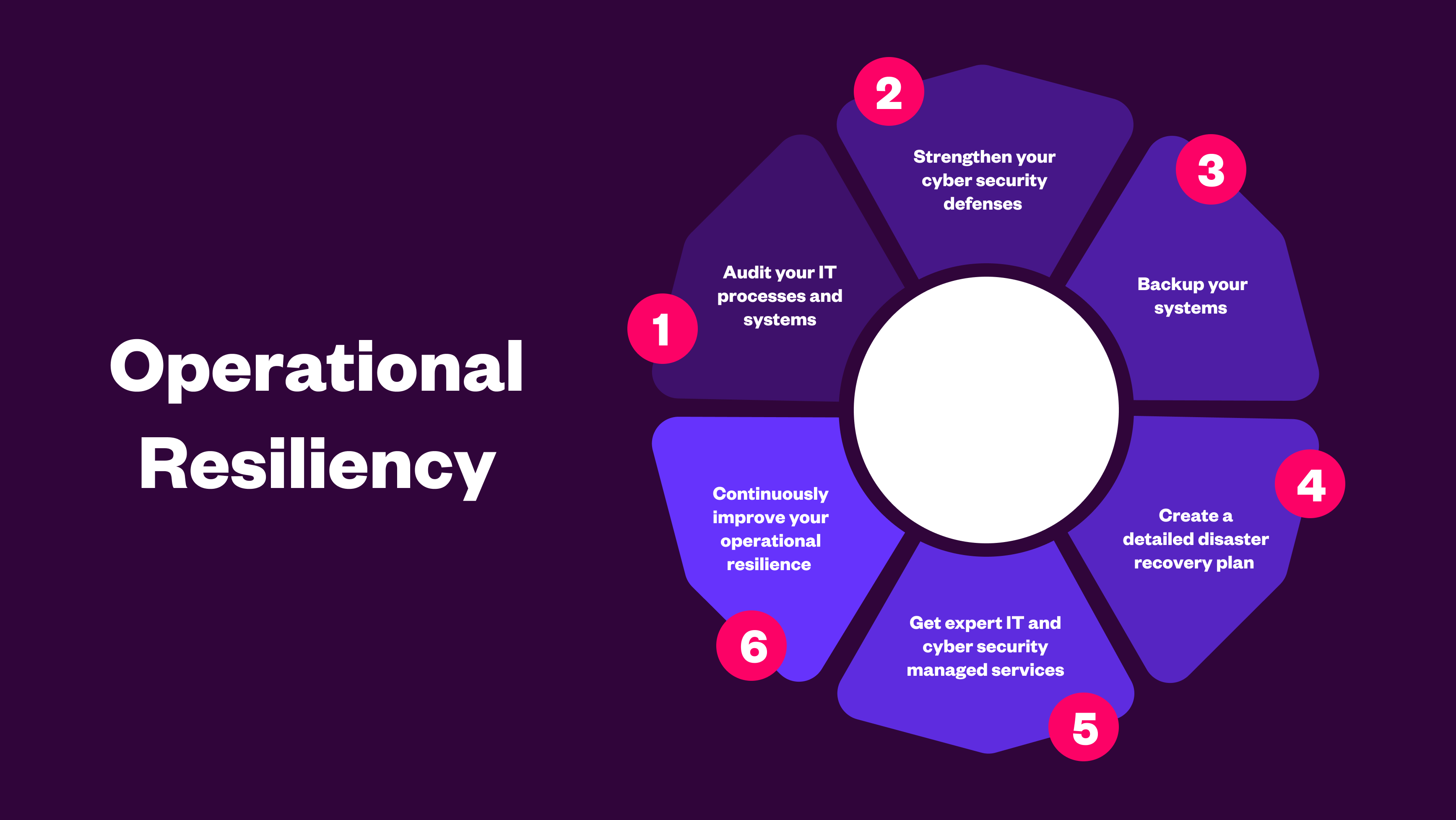
Effective cyber defence strategies are continuous programmes, not one-off projects.
-
Assess risk exposure: Identify - critical systems, high-risk users, third-party dependencies, internet-facing assets and recovery priorities
-
Prioritise operational visibility: Focus on - centralised logging, endpoint visibility, identity monitoring, cloud telemetry and threat correlation.
-
Establish response processes: Clear escalation and response procedures reduce confusion during active incidents. Preparation improves containment speed.
-
Integrate security and recovery: Security without recovery readiness creates operational risk. Cyber resilience requires backup validation, recovery testing, immutable storage, recovery orchestration and incident simulation.
-
Continiously improve: Threats evolve continuously. Security strategies should evolve alongside infrastructure changes, regulatory requiremenets, business growth, emerging attack methods.
Managed cyber security provides operational continuity that supports ongoing improvement over time.
Security operations need to move faster than threats
Cyber security is no longer just about prevention. Modern defence strategies depend on visibility, speed, operational readiness, continuous monitoring, rapid containment and recovery capability.
Most organisations already have security technologies in place. The challenge is operational execution. Managed cyber security, such as Celerity UK, helps close that gap. It gives organisations access to continuous protection, specialist expertise, and faster response capabilities without the overhead of building a full-scale internal SOC operation. The organisations that respond fastest are often the organisations that recover fastest.
And in modern cyber security, speed matters. Protection starts with a conversation. Let’s talk.






.png)
.png)