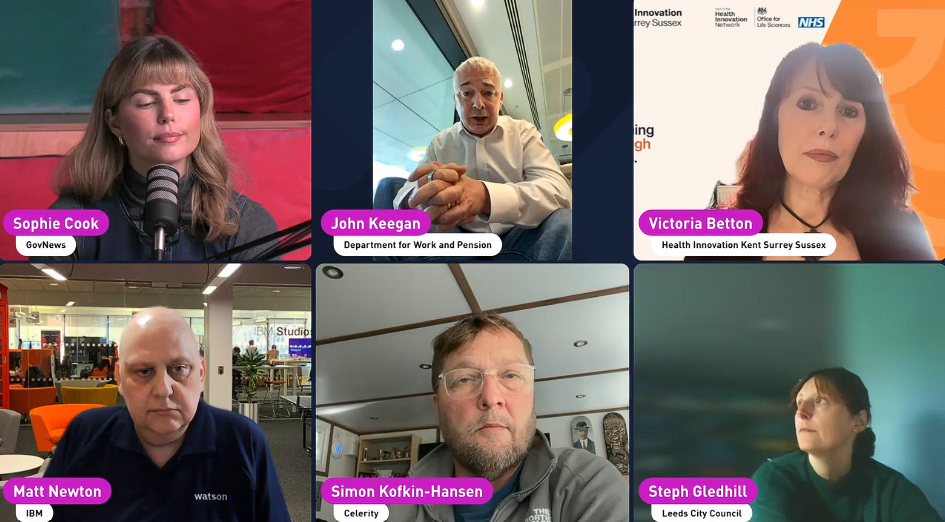
Insights from our recent webinar with GovNews and IBM: "From AI Strategy to Scaled Deployment: Delivering Productivity Gains Now"
The gap between AI experimentation and real-world impact is the defining challenge facing public sector organisations today. Most have moved past the initial excitement. Many have run pilots. But the question that keeps surfacing in boardrooms and steering groups alike is deceptively simple: how do we make this work at scale?
That was the focus of our recent webinar, delivered in partnership with GovNews and IBM, where digital and security leaders from the DWP, Health Innovation Kent Surrey Sussex, and Leeds City Council joined Celerity's own Innovation Lead, Simon Kofkine Hanson, and IBM's Matt Newton to share what's actually working, and what's getting in the way.
If you missed it, you can watch the full session on demand. But here are the key takeaways worth carrying into your own AI strategy.
The definition of success has changed
One of the earliest and most telling moments in the discussion came from Simon, who offered a refreshingly practical litmus test for AI success: "When an AI agent goes down and people start complaining that it's not available, you know you've actually hit the norm."
That shift from AI as a novelty to AI as a dependency, is where the real value lies. John Keegan from DWP reinforced this point. The department has moved well beyond pilots in its internal operations, deploying Microsoft Copilot across a workforce of 130,000 people and embedding AI deeply into IT operations and security. The emphasis isn't on a single killer use case but on making AI a normal part of how work gets done, from triaging IT incidents to assisting security analysts in reducing false positives and investigating threats faster.
The message was clear: success isn't defined by the sophistication of the technology. It's defined by whether people would notice if it disappeared.
Real examples, real productivity gains
The panel didn't deal in abstractions. Leeds City Council shared how they've started to bring AI into their planning department, not to automate decisions, but to reduce the time officers spend on repetitive drafting, policy cross-referencing, and structuring recommendations. Steph Gledhill was careful to emphasise that professional judgement and governance remain with the planning officers. The AI is positioned as decision support, not decision-making. That distinction matters, and it's a big reason the initiative has been shortlisted for the Planning Awards.
DWP described how AI is now embedded in back-office IT problem determination. Where support engineers previously spent hours searching knowledge bases and external sources to diagnose issues, AI now analyses incoming tickets and presents resolution options in minutes. The department is even running AI-generated fixes through DevOps pipelines to test accuracy before deployment, work that used to take days or weeks.
Dr Victoria Betten from Health Innovation Kent Surrey Sussex highlighted a clinical triage product called Rapid Health that achieved 91% take-up and freed enough capacity for GP practices to extend appointment times from 10 to 15 minutes. That's not just an efficiency metric; it's a meaningful improvement in patient care.
And from the private sector, Simon shared a case where AI automated order matching for a manufacturing client, taking eight people off repetitive ERP screen work and redeploying them into higher-value roles in support and technical sales. The system was even able to identify incorrect product numbers and resolve them conversationally with customers.
The biggest barriers aren't technical, they're cultural
Every panellist agreed: the hardest part of scaling AI isn't the technology. It's the people.
Steph from Leeds was direct about this. Initial concerns around data protection and job safety have evolved into deeper questions about the ethical use of AI, its environmental impact, and perhaps most practically, whether staff have the time and support to learn new tools. "A lot of people just think, 'Oh, we've introduced AI, they can just use it,' but it's a big learning curve," she said. When workforces are already stretched thin, finding that learning capacity becomes a genuine barrier.
Victoria echoed this from a healthcare perspective. She described running AI essentials training for doctors and watching clinicians go "from absolute skepticism to 'Oh my god, how can I get this tomorrow?'" in a single session, once they experienced a simulation of ambient voice technology. Her takeaway was powerful: "By just going that bit slower at the beginning, you can go a lot faster later on."
John from DWP described how the department addressed cultural barriers by creating a network of "digital champions", passionate non-technical staff embedded in offices up and down the country who train their local colleagues on how to use AI tools effectively.
And Simon added the technology leadership perspective: AI literacy is now paramount, particularly as organisations move from basic prompt engineering toward more complex integrations with multiple models and MCP (Model Context Protocol) servers. The next wave of adoption will require people who understand not just how to use AI, but when not to use it.
Governance that enables rather than blocks
A recurring theme was the tension between safety and speed. Every organisation on the panel had, at some point, put the brakes on AI access and then found a way to responsibly open things back up.
DWP initially restricted external AI access before building guardrails around Microsoft's Copilot ecosystem. They've since implemented visibility tools to monitor where AI is being used, which models are in play, and what safeguards are in place against threats like prompt injection. John's approach was pragmatic: "We don't want to stifle innovation, but we also want to do that in a safe and secure way."
The panel's consensus was that governance shouldn't be a gate that slows everything down. It should be a framework that gives teams confidence to move forward, secure by design, with humans in the loop where decisions carry real weight.
What comes next: from "tell me" to "do it for me"
Looking ahead, Matt Newton from IBM framed the trajectory of AI adoption neatly: "Tell me, show me, do it for me." Early AI use was about information retrieval. Then it moved to demonstration and guidance. Now, organisations are reaching the point where AI can autonomously execute tasks, resetting passwords, processing orders, running diagnostics, with human oversight rather than human effort.
Victoria highlighted ambient voice technology as a massive opportunity for the NHS, where clinicians spend up to 50% of their time on documentation rather than patient care. National funding is now being deployed to roll out AVT across NHS regions, with a register of approved providers already in place.
John pointed to benefits administration at DWP, a department that pays £288 billion per year, where AI can improve accuracy, reduce administrative toil, and free up frontline staff to spend more face time with citizens in job centres.
And Simon struck a note of pragmatic caution that resonated with the whole panel: "We also have to recognise that AI isn't the answer to everything sometimes. And we need to be big enough to say, 'That's not right,' and stop it."
Think big, start small, and don't boil the ocean
If there was a single thread that ran through the entire hour, it was this: ambition is important, but disciplined execution is what gets results. Think big about where AI can transform your organisation. But start with a focused use case, co-design it with the people who'll use it, and prove value before scaling.
Matt put it succinctly: "The moment you try to boil the ocean at once, your project will fail."
Experience AI in action
We're continuing the conversation with an in-person, invitation only hands-on workshop at IBM's London Innovation Studio on 25 June. You'll meet Bob, an AI agent and experience practical use cases first-hand through guided labs and facilitated discussion focused on public sector challenges.
Register your interest for the workshop
Register your interest