

Data Resilience
Secure data optimisation & proactive backup
Proactive Licensing, Compliance & Asset Management
Agile, Modular, & Secure Cyber Security & Managed Siem
Manage & Transform Multi-Cloud, Hybrid & On-Premise
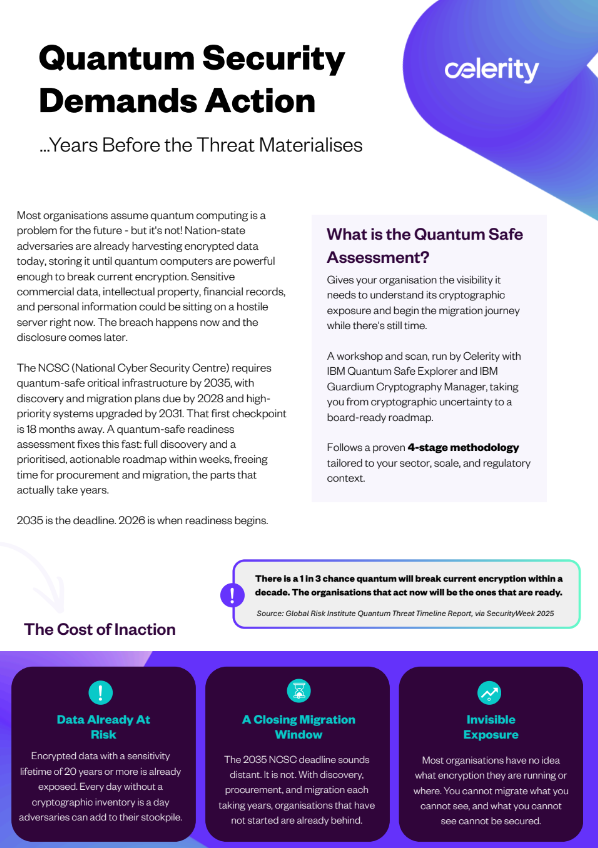
Attackers are already stealing encrypted data so they can unlock it once quantum computers are powerful enough.
The NCSC ( National Cyber Security Centre) has set 2035 as the target for UK organisations to complete their move to quantum-safe cryptography, and the first milestone is 2028. Organisations that start now can choose their path.
Those that wait will be migrating under pressure.
Most internet encryption relies on maths that today’s computers cannot solve in a practical time. Quantum computers are expected to solve some of them, which would make much of that encryption easy to break.
Criminals and state actors can copy encrypted data today and decrypt it once quantum technology arrives. Data that must stay confidential for 10+ years, such as patient and financial records, is already at risk.
Post-quantum cryptography resists quantum attacks. Migrating touches applications, servers, devices and suppliers, so the first step is knowing where your encryption lives.

Most internet encryption relies on maths that today’s computers cannot solve in a practical time. Quantum computers are expected to solve some of them, which would make much of that encryption easy to break.
Criminals and state actors can copy encrypted data today and decrypt it once quantum technology arrives. Data that must stay confidential for 20+ years, such as patient and financial records, is already at risk.
Post-quantum cryptography resists quantum attacks. Migrating touches applications, servers, devices and suppliers, so the first step is knowing where your encryption lives.
In March 2025, the NCSC set a three-milestone timeline for UK organisations to move to post-quantum cryptography.
It is guidance rather than law, but regulators, insurers and auditors are likely to measure your progress against it.
Agree ownership, find your quantum risks and rank them.

Define your migrations goals, complete a full discovery of the cryptography across your estate, and build an initial migration plan.

Complete your early, highest priority migration activities and refine the plan into a full roadmap.

Migration is complete across your system, services and products.
Begin discovery discussions and planning ahead.
Complete a full discovery of your estate, and build an initial migration plan.
Have migrated your critical prioritised assets.
Migration is complete across your systems, services and products.
Discovery is the slowest part of the process. Starting today leaves time to choose your path.
Select your role to see what the assessment answers for you.
Know what is exposed and what migration will disrupt
You own the infrastructure and applications that hold the data. The assessment shows which systems use vulnerable cryptography and how to sequence the work so the business keeps running.
Show regulators and insurers a credible plan
You are accountable for protecting the data and for evidencing that protection. The assessment gives you a prioritised risk register and a plan you can put in front of auditors.
Turn an open-ended risk into a budget line
Quantum migration is a multi-year programme. The assessment converts it into a phased, costed roadmap that the board can approve, rather than an unknown liability.
A structured five-step assessment, delivered by IBM and Celerity experts, takes you from cryptographic uncertainty to a board-ready plan.
white paper
Our two-page datasheet helps you understand what quantum safe means for your organisation, how the five-step assessment works and exactly what you receive.
Download datasheet
Our cyber security consultant Holly Ellwood and IBM's Hamish Cunningham give a short introduction to why quantum safe migration matters now, and what the Quantum Safe Assessment involves.
No. The assessment begins with discovery, so it works for organisations at any stage. Most arrive without a cryptographic inventory, and building one is the first deliverable.
Quantum safe cryptography, also called post-quantum cryptography, uses algorithms designed to resist attacks from quantum computers. Organisations need to move their existing encryption onto these algorithms before quantum computers are capable of breaking the current ones.
Read more about the Quantum threat and response with our below resources
Why harvest now, decrypt later matters for sensitive data, and how to start building a quantum-ready strategy.
Download Whitepaper

An introduction to the quantum encryption threat and the practical steps organisations can take now.
Read Blog

In this thought-provoking video podcast, Celerity, GovNews and healthcare leaders explore how quantum computing could disrupt digital systems and what that means for data security, resilience, and clinical outcomes.
Watch Podcast