Your IBM i platform runs the workloads your business can't afford to lose. But if a ransomware attack hit tomorrow, could you recover in hours, or would you be reaching for a tape?
The latest generation of IBM FlashSystem, the 5600, 7600, and 9600, delivers more than a step up in storage performance. For organisations running mission-critical IBM i workloads, these systems introduce storage-level cyber resilience that fundamentally changes how quickly and confidently you can recover from an incident.
At Celerity, we've been partnering with IBM for over 25 years to deliver resilient IT infrastructure and advanced data security. We work with IBM i customers every day who are reassessing their recovery posture, and the new FlashSystem generation gives them a compelling reason to act now.
Safeguarded Copy: Recovery, Not Just Backup
Most IBM i environments still rely on nightly backup windows, often to tape, as their primary safety net. The problem isn't that these backups don't exist. It's that when you actually need them, the recovery process is slow, uncertain, and often untested under real pressure. As the IBM Cost of a Data Breach Report makes clear, the financial and operational consequences of slow recovery are escalating year on year.
IBM FlashSystem's Safeguarded Copy takes a fundamentally different approach. It creates policy-driven, immutable snapshots at the storage layer, recovery points that cannot be deleted, overwritten, or encrypted by ransomware, a malicious insider, or anyone else. They are logically air-gapped, and immutability is total: the snapshots cannot even be moved.
For IBM i specifically, this is significant. Your most critical recovery asset, a clean, known-good copy of your system, is preserved entirely outside the reach of anything running in the OS. Whether you're dealing with a full ransomware compromise or a more routine data corruption from a failed application change, the recovery point is protected.
When recovery is needed, FlashSystem offers two clear paths: a direct restore (returning production back to a snapshot point in time) or a recover option, which creates a fresh copy that can be presented to a separate partition for validation before you commit. That second option, the ability to verify a snapshot is clean and corruption-free before staking your business on it, is exactly the kind of cleanroom recovery approach that is becoming essential for regulated industries.
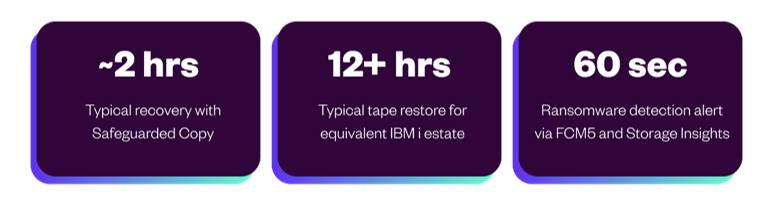
In a ransomware scenario, the difference between a two-hour recovery and a twelve-hour recovery isn't just about productivity. It's often the difference between a manageable incident and a business-threatening crisis. For organisations that need to go further and automate that entire recovery process for IBM Power environments, our CopyAssure service reduces recovery times from 12 hours to as little as 15 minutes, with validated, immutable recovery points tested continuously.
Flash Core Modules: Built-In Intelligence at the Drive Level
A common concern with snapshot-based protection is the additional storage capacity required. For IBM i environments, the answer is likely less than you'd expect.
The physical drives inside FlashSystem, Flash Core Modules, now in their fifth generation (FCM5) carry their own on-board processors that do real work. Every I/O operation is analysed in real time for ransomware behaviour patterns. Connect your FlashSystem to IBM Storage Insights via call-home and you receive ransomware detection alerts within 60 seconds, with no performance impact. This kind of storage-level threat awareness complements the broader exposure management and managed detection and response capabilities that organisations need across their full environment.
Data is also automatically encrypted and compressed at the drive level as it's written, without consuming your performance headroom. This is where the capacity picture becomes particularly favourable for IBM i. Because IBM i data is inherently well-ordered, thanks to its integrated database and object architecture, it compresses exceptionally well on FCM drives. Real-world compression ratios of 2:1 to 4:1 are realistic, meaning 9TB of actual IBM i data might only consume around 3TB of physical capacity.
Critically, Safeguarded Copy storage usage isn't cumulative in the way many people assume. Only data that has changed since a snapshot was taken is written to preserve that recovery point. If the same block changes a thousand times between snapshots, only the single copy needed to maintain integrity is stored, not a thousand versions. Unlike IBM i journals, the overhead is directly proportional to your actual data change rate, not the volume of transactions.
Smarter Replication for Tighter Recovery Objectives
Replication has been meaningfully improved in this generation. By assigning a replication policy to your volume group, FlashSystem continuously optimises your Recovery Point Objective based on actual replication throughput and available bandwidth, rather than requiring manual configuration of cycling modes.
Standard IBM i replication considerations still apply, switching replication direction still requires an abnormal IPL, and you still can't independently upgrade the target system's OS. These are platform constraints rather than FlashSystem limitations, but they're worth factoring into your disaster and cyber recovery planning.
Policy Based High Availability: Beyond Hyperswap
Policy Based High Availability (PBHA) supersedes the older Hyperswap approach, delivering improved fault tolerance, lower latency, and better performance. The concept is powerful: enrol your IBM i volume group into a Storage Partition, assign a two-site HA topology, and the system creates resilience across two independent FlashSystem devices. IBM i's built-in multipath drivers handle the rest, keeping the OS, data, and I/O flowing even if one storage device is completely lost.
PBHA reflects a broader shift in how FlashSystem approaches workload mobility, whether for planned migrations, maintenance windows, or unplanned DR invocations. This is storage infrastructure that actively participates in keeping you operational, which aligns with the wider approach Celerity takes to managing IBM Power environments proactively rather than reactively.
Where Does This Fit in Your Resilience Strategy?
IBM FlashSystem's Safeguarded Copy delivers something genuinely distinctive for IBM i: operational resilience and cyber recovery built into the storage layer, not bolted on top of it. And IBM has designed these tools to be accessible, you don't need to be a career-long storage administrator to set them up.
But storage-level protection is one piece of a broader resilience picture. For organisations in financial services, healthcare, or the public sector, regulatory expectations around recoverability, from DORA to NIS2 to the NHS DSP Toolkit, now demand that you can prove your recovery capability, not just describe it. Our recent blog on operational resilience and the DORA mandate for IBM Power explores what that means in practice.
The question for IBM i architects and IT leaders today isn't whether a ransomware event is plausible. It's whether your recovery capability is already in place when it happens. If your current answer is "we'd be relying on tape," it's time to explore what modern storage-level resilience, combined with tested, automated recovery, can do for your organisation.
For a deeper dive into building a recovery-first architecture, download our ebook: Enabling Modern Cyber-Resilience with IBM Storage.
Ready to assess your recovery readiness? Get in touch with our team to discuss your IBM Power environment and explore how Celerity can help you move from backup to assured recovery.



.png?width=1920&height=1080&name=blog%20images%20(27).png)
.png?width=1920&height=1080&name=blog%20images%20(28).png)
.png)

.png)

.png)