Key Takeaways
- The NIST framework for cyber security provides a proven approach to managing cyber risk.
- The framework consists of six core functions that improve cyber resilience.
- It helps organisations identify priorities, strengthen governance and improve incident response.
- UK organisations can use the framework to demonstrate cyber security best practice and build stakeholder confidence.
- Celerity helps businesses assess, implement and mature their cyber security capabilities using the NIST Cybersecurity Framework.
What is the NIST Cyber Security Framework?

When it comes to managing and reducing your cyber security risk, the NIST framework for Cyber Security is the most robust and accessible set of guidelines, aligning your entire organisation.
The National Institute of Standards and Technology (NIST) Cyber Security Framework is made up of six essential functions to ensure businesses can manage and mitigate their cyber security risks. This is not a regulation that must be abided by, but rather a voluntary set of guidelines for achieving cyber security best practices.
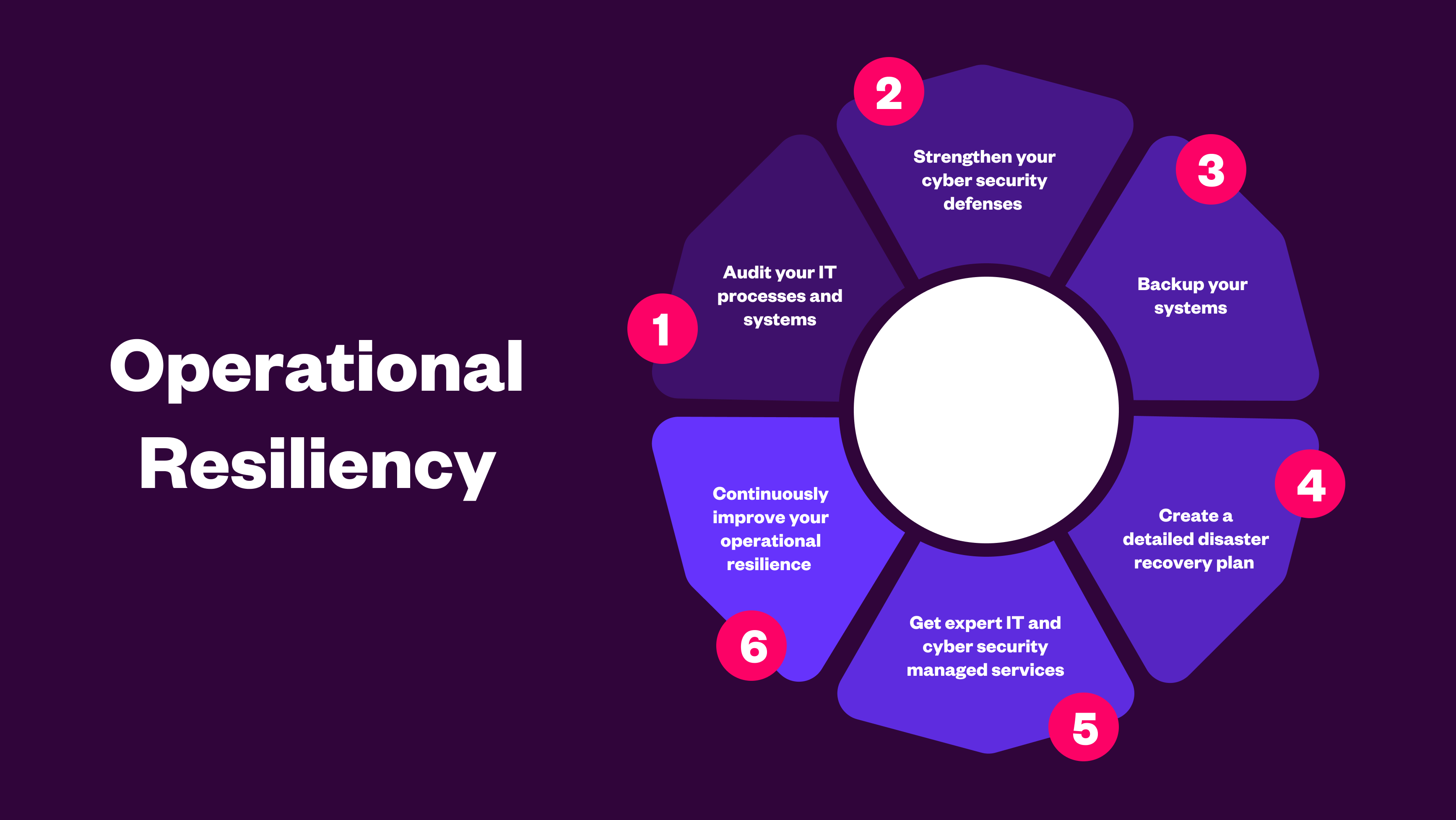
This framework is accessible and impactful, empowering your teams to see and stride towards a clear path to operational resilience, for total peace of mind. In this article, we outline the six functions of the NIST Cyber Security Framework, as well as a concise breakdown of how your organisation should put these functions into practice.
By aligning with these functions, you can achieve operational resilience through implementing cyber security best practice.
What are the six functions of the NIST Cyber Security Framework?
1. Govern
The Govern function provides the foundation for every cyber security programme.
It focuses on creating the strategies, policies and governance structures needed to manage cyber security risk effectively.
Your organisation should establish:
- Clear cyber security objectives aligned with business goals.
- Executive and stakeholder ownership of cyber security responsibilities.
- Risk management strategies that define how identified risks will be treated.
- Policies, governance processes and performance measures to monitor success.
Strong governance ensures cyber security becomes a business priority rather than simply an IT responsibility.
2. Identify
The Identify function focuses on understanding what needs protecting and where the greatest risks exist. This begins with developing a complete inventory of your critical assets, systems, applications and data, often referred to as identifying your minimum viable company.
Key activities include:
- Identifying all assets requiring protection.
- Assessing business-critical systems and data.
- Understanding current cyber risks across departments.
- Prioritising the risks that require immediate attention.
Without visibility, organisations cannot make informed security decisions.
3. Protect
The Protect function covers the safeguards needed to reduce the likelihood of a successful cyber attack.
These controls typically include:
- Restricting access to critical systems using least-privilege principles.
- Delivering cyber security awareness training to employees.
- Protecting sensitive data from both external and insider threats.
- Maintaining secure backups and ensuring systems remain supported.
Proactive protection significantly reduces overall cyber risk while improving business resilience.
4. Detect
No organisation can prevent every cyber incident. The Detect function focuses on identifying threats quickly before they cause widespread disruption.
Effective detection includes:
- Identifying suspicious behaviour and anomalies.
- Continuous monitoring of systems and networks.
- Vulnerability monitoring.
- 24/7 threat detection through managed security services.
Earlier detection allows organisations to contain incidents before they escalate.
5. Respond
Every organisation should assume that, at some point, a cyber incident will occur.
The Respond function ensures your business can react quickly and minimise operational disruption.
This includes:
- Maintaining a documented incident response plan.
- Keeping critical business services operational during an incident.
- Having communication plans for regulators, customers and stakeholders.
- Investigating incidents thoroughly and updating security controls afterwards.
Well-tested incident response plans dramatically reduce downtime and recovery costs.
6. Recover
Recovery focuses on restoring operations safely following a cyber incident.
To align with this function, organisations should:
- Recover systems, data and services efficiently.
- Test disaster recovery plans regularly.
- Ensure stakeholders understand recovery procedures.
- Continuously improve disaster recovery processes following incidents.
Strong recovery capabilities help minimise financial losses and operational disruption.
The Benefits of Following the NIST Framework
Implementing the framework delivers benefits beyond cyber security.
It helps organisations:
- Improve governance and accountability.
- Increase operational resilience.
- Reduce downtime and recovery costs.
- Demonstrate cyber security maturity to customers and partners.
- Support compliance with wider security standards.
For example, Celerity helped a London Borough Council safeguard critical services through Backup as a Service and Disaster Recovery as a Service, reducing operational and administrative costs by 54%.
Why the NIST Framework Matters for UK Businesses
Although NIST originates from the United States, it has become the global benchmark for cyber security best practice. For UK organisations, adopting the framework demonstrates a proactive approach to cyber risk management and can support wider governance, compliance and operational resilience objectives.
While most UK businesses are not legally required to adopt NIST unless working with US government organisations, many choose to follow it because it:
- Demonstrates commitment to protecting customer and business data.
- Improves resilience against cyber attacks.
- Strengthens governance and executive oversight.
- Supports bids for government and international contracts.
- Builds confidence with customers, regulators and stakeholders.
The framework also encourages closer collaboration between technical teams and business leadership, creating a culture where cyber security becomes everyone's responsibility.
"Adopting the NIST Cybersecurity Framework enables organisations to systematically govern, identify, protect against, detect, respond to and recover from cyber threats. By integrating these core functions, enterprises can strengthen their cybersecurity posture, enhance operational resilience and safeguard critical assets and sensitive data against evolving threats."
Steven Laidler
Implementing the NIST Cybersecurity Framework
For larger organisations, implementing the framework can be a significant undertaking. Understanding your current level of cyber maturity is the best place to begin.
Celerity's Cyber Security Maturity Assessment benchmarks your organisation against the NIST Cybersecurity Framework, helping identify strengths, weaknesses and priority areas for improvement.
Combined with our managed cyber security services, we help organisations implement practical improvements without overburdening internal teams.
Speak to Our Cyber Security Experts
Whether you're just starting your cyber security journey or looking to mature an existing programme, Celerity's specialists can help you implement the NIST framework for cyber security in a practical, business-focused way.
To help strengthen your organisation's resilience, we've also created our What Boards of Directors Must Know About Ransomware guide. It explores the governance responsibilities of senior leaders, explains today's evolving ransomware threat landscape and outlines the strategic decisions boards should be making to improve cyber resilience.
If you're ready to strengthen your cyber security posture, speak to our cyber security experts today or take our Cyber Security Maturity Assessment.
Frequently Asked Questions
The NIST framework for cyber security is a globally recognised set of best practice guidelines developed by the National Institute of Standards and Technology to help organisations manage and reduce cyber security risk.
The six functions are Govern, Identify, Protect, Detect, Respond and Recover. Together they provide a structured approach to improving cyber resilience.
No. Most UK organisations are not legally required to adopt the framework. However, it is widely regarded as a cyber security best practice and is often used to improve resilience and demonstrate security maturity.
Celerity provides cyber security consultancy, managed security services and Cyber Security Maturity Assessments that benchmark your organisation against the framework and provide practical recommendations for improvement.
A maturity assessment identifies strengths, weaknesses and areas for improvement across your cyber security programme, helping you prioritise investment and build a roadmap towards stronger cyber resilience using the NIST Cybersecurity Framework.





.png)
.png)